Revise

Scholarly publishing software

Editorial infrastructure for journals that run on goodwill.

Most journals are expected to meet the same standards as the large commercial publishers, without the production departments those publishers can afford. Revise is built for that gap — peer review and production software a small editorial team can actually run.

How a manuscript moves through Revise A flow in two rows. Top row, Revise[Submit]: submission intake, peer review, editorial decision. The flow then passes through an acceptance gate carrying manuscript and metadata, into the bottom row, Revise[Production]: JATS XML production, author proofing, publication output. ACCEPTANCE manuscript + metadata 01 02 03 04 05 06 REVISE[SUBMIT] REVISE[PRODUCTION] Submission intake Peer review Editorial decision JATS XML production Author proofing Publication output
Six stages, one gate. The manuscript passes acceptance once, carrying its metadata with it.

Two platforms, one manuscript.

A journal's work breaks cleanly in two at the moment of acceptance. Revise covers both halves.

Before acceptance

Revise[Submit]

submit.revise.id

Everything from the moment a manuscript arrives until an editor reaches a decision.

Authors submit through a guided portal. Editors triage, assign reviewers from the contact database, run as many revision rounds as the manuscript needs, and issue structured decision letters. The reviewer pool, segments, and outreach live in the same system rather than a spreadsheet beside it.

Submission intake
Peer review
Revision rounds
Editorial decisions
Reviewer database
Email campaigns
Revise[Submit] in detail
After acceptance

Revise[Production]

production.revise.id

Everything that turns an accepted manuscript into a published article.

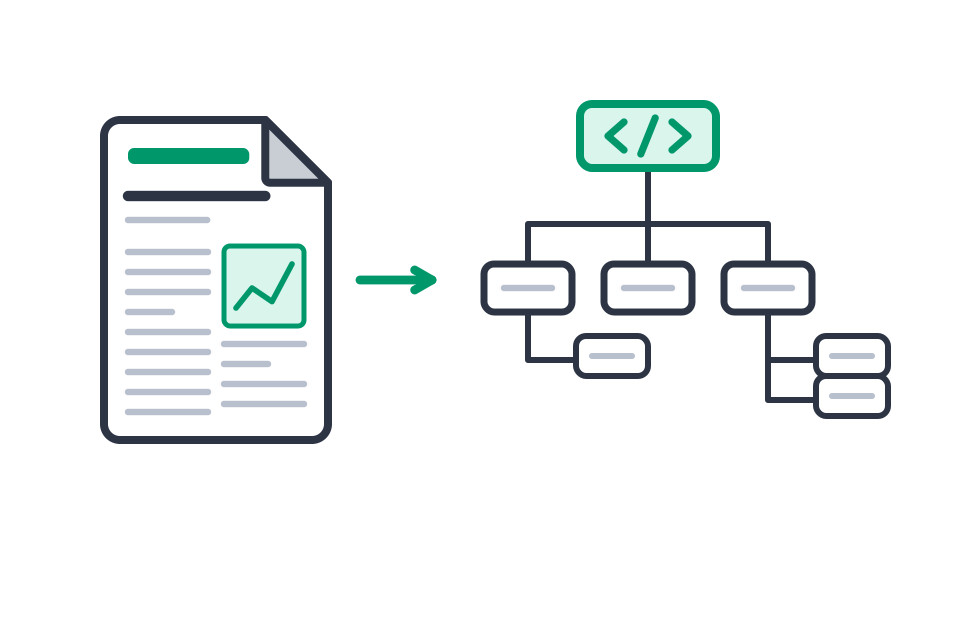
Content and metadata are structured into valid JATS XML through a visual editor, with references auto-filled from CrossRef DOIs. Proofs go to authors in the browser, corrections and queries are tracked in one thread, and the final PDF and XML come out the other end ready to deposit.

JATS XML editing
Metadata & references
Standards validation
Author proofreading
Query tracking
Publication output
Revise[Production] in detail

The workflow

Acceptance is the only handoff.

The manuscript crosses that line carrying its metadata with it. Nothing is exported, re-typed, or emailed to a vendor.

  1. 01 Revise[Submit]

    Submit & review

    Authors submit through a guided portal with metadata captured up front. Editors triage, invite reviewers from the contact pool, and track who has responded.

  2. 02 Revise[Submit]

    Decide

    Accept, reject, or request revisions with structured decision letters. Revision rounds repeat as needed, each version tracked against the last.

  3. 03 Revise[Production]

    Produce

    The accepted manuscript arrives with its metadata intact and is structured into valid JATS XML, references auto-filled from CrossRef.

  4. 04 Revise[Production]

    Proof & publish

    Authors mark corrections on the proof in the browser and answer queries in the same thread. Final PDF and XML come out ready to deposit.

Three people have to live in this software. It should work for all of them.

Editors

Most editors do this work unpaid, alongside a full research job. The queue has to be readable in ten minutes: what arrived, what is waiting on a reviewer, what is waiting on a decision. Nothing that requires a training course to operate.

Publishers

Running several titles means caring about standards compliance, per-title configuration, and what happens if you leave. Your content stays in open formats — JATS XML and PDF — so bringing production in-house does not mean being locked into us.

Authors

An author meets the software twice: once at submission and once at the proof. Both should be finishable in one sitting, on a laptop, without an account manual — and the status of the manuscript should never be a mystery.

Where we stand

The decisions behind the software.

One handoff, not one export
Acceptance is the only point where a manuscript changes hands, and it crosses carrying its metadata. There is no export step, no re-typing, and no file emailed to a typesetting vendor.
It sits next to OJS
Revise is not a replacement campaign against Open Journal Systems. Journals run OJS for good reasons; Revise is for the parts of the workflow a journal wants to run differently.
Deliberately ordinary technology
Laravel, Livewire, and Tailwind. A stack a university IT department can host, staff, and audit without specialist help — chosen for longevity rather than novelty.
Your infrastructure or ours
Self-host on your own servers, or let us run it. The software is the same either way, and the choice is reversible.
Built where the constraint is real
Revise is built in Indonesia, for journals whose budgets make most publishing software unaffordable. That constraint shaped the product rather than being discovered after launch.
Output that meets the standards
Valid JATS XML, CrossRef-ready metadata, and archive-ready PDF. A small journal should not have to publish to a lower standard than a commercial one.

No rate card yet, on purpose.

A society journal publishing forty articles a year and a press running twelve titles are not the same customer, and a published price would be wrong for both. Tell us the shape of your operation and we will quote against it.

Sized to the journal

Quoted on titles, submission volume, and which of the two platforms you need — not per seat.

Global South & Diamond OA

Journals with no article charges and no institutional backing are the reason Revise exists. Say so and it is reflected in the quote.

Self-hosted or managed

Run it on your own infrastructure with a licence, or have us host and maintain it. Both are priced.

Questions

Asked before, answered plainly.

If yours is not here, write to us.

Editorial infrastructure for scholarly journals: the software a journal uses to run peer review, and to produce the published article. Two platforms, split at the moment of acceptance.

Tell us about your journal.

Not a signup form and not a sales sequence — an email that reaches someone who works on this. If Revise is not the right fit for your situation, we would rather tell you that early.

hello@revise.id · usually answered within one working day